MIMIC — Capstone Project
A Concordia-McGill collaboration building bimanual mobile robots for imitation learning research — from low-cost prototypes to industrial Kinova arms.
Overview
MIMIC is an interdisciplinary capstone project in collaboration with McGill's Mobile Robotics Lab (MRL). The goal: develop bimanual mobile robots that learn tasks through imitation, bridging the gap between low-cost research platforms and industrial-grade systems.
This project is a direct continuation of my LeRobot summer exploration — taking the concepts we learned and applying them to real hardware at both ends of the cost spectrum.
The Two-Pronged Approach
Concordia Side: Low-Cost Research Platform
Build an affordable, reproducible bimanual mobile robot for rapid experimentation:
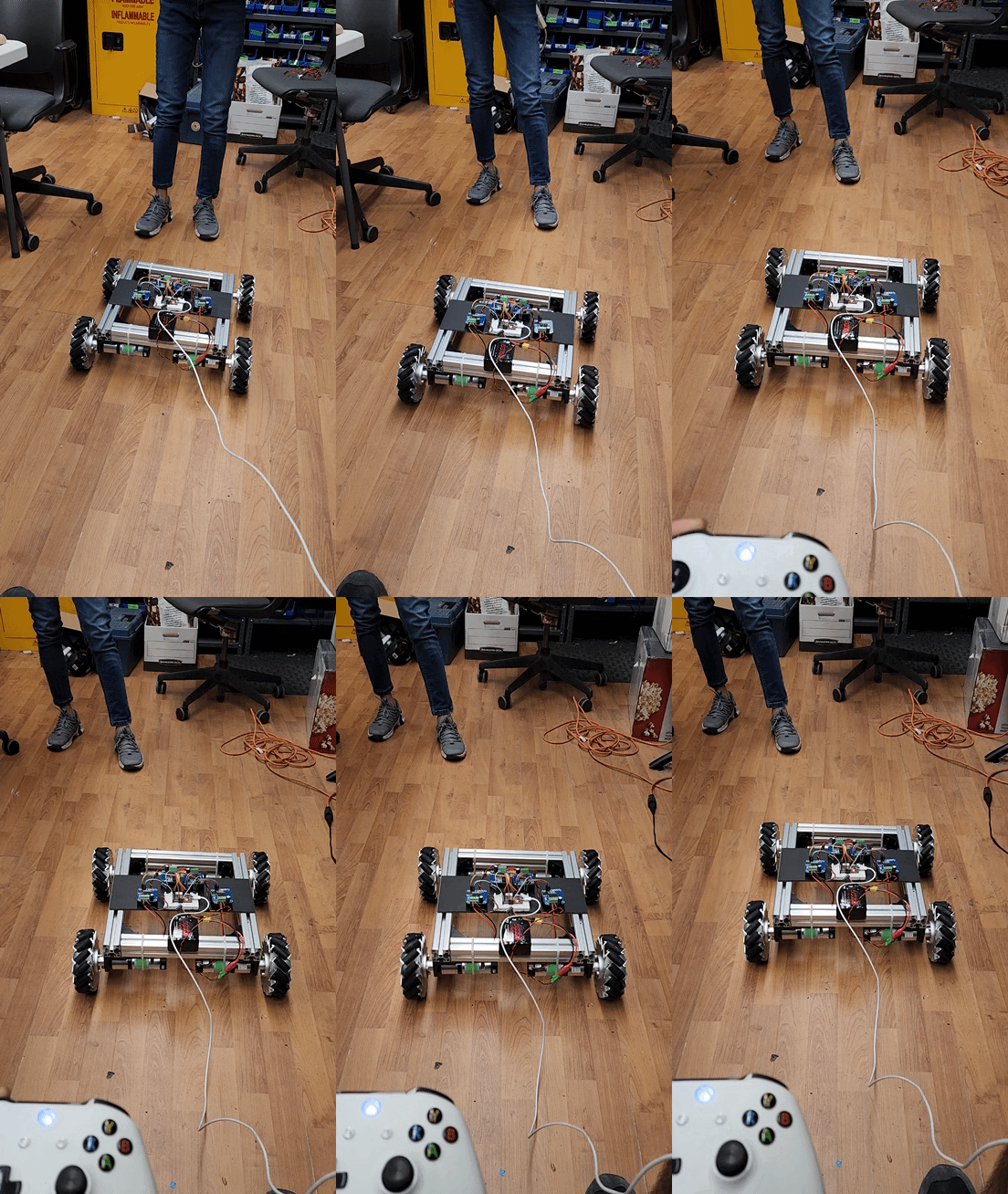
- Mobile base: Mecanum wheels (matching MOVO's architecture)
- Arms: Two SO-101 arms from the LeRobot ecosystem
- Purpose: Test VLA approaches, collect training data, iterate quickly
McGill Side: Industrial Robot Revival
Bring MOVO back to life — an industrial bimanual mobile robot by Kinova:
- Hardware: Two Kinova Jaco arms on a mobile base
- Challenge: The robot was out of commission (old, dusty, non-functional)
- Goal: Full restoration + custom teleoperation system for data collection
Why Both?
MOVO is expensive, access is limited, and testing on industrial hardware is risky. Our low-cost platform mirrors MOVO's architecture so everything we develop transfers directly:
| Aspect | Low-Cost Platform | MOVO |
|---|---|---|
| Base | Mecanum wheels | Mecanum wheels |
| Arms | SO-101 (2x) | Kinova Jaco (2x) |
| Cost | ~$2,000 | ~$100,000+ |
| Access | Unlimited | Scheduled lab time |
| Risk tolerance | High | Low |
Technical Work
Teleoperation System
MOVO's Jaco arms have no intuitive control method for collecting imitation learning data. We're building custom teleoperator arms that map human motion to robot motion in real-time.
Data Collection Pipeline
- Camera placement optimization for VLA training
- Synchronized recording of observations and actions
- Dataset formatting for LeRobot/Hugging Face ecosystem
Model Training
- Behavior cloning on collected demonstrations
- Testing state-of-the-art VLA architectures
- Potential development of custom models in collaboration with McGill MRL
Team
Interdisciplinary Capstone — not a single-department project.
| Role | Members |
|---|---|
| Project Leads | Me (Concordia) + Partner (McGill) |
| Mechanical Engineering | 2 students |
| Electrical/Computer Engineering | 3 students |
| Computer Science | 1 student |
Supervisors
- McGill: Dr. Meyer (MRL Lab Director) + Master's student advisor
- Concordia: Dr. Krzysztof Skonieczny (CUARL Director — my summer research supervisor)
Current Status
- ✅ Low-cost platform mechanical assembly complete
- ✅ Bimanual SO-101 arms integrated with LeRobot
- ✅ Mobile base operational in ROS2
- 🔄 MOVO restoration in progress
- 🔄 Teleoperation system development
- ⏳ Data collection for complex bimanual tasks
- ⏳ VLA model training and evaluation
The Bigger Picture
This isn't just a capstone — it's a research pipeline. Everything we learn about data collection, camera placement, and model training feeds into potential publications with McGill MRL. The low-cost platform makes this research reproducible; the MOVO integration proves it scales to industrial hardware.